
Asian Americans Advancing Justice | AAJC Analysis of Preliminary 2025 FBI Data
April 17, 2026Persistent and Emerging Threats Against Asian Americans and their faith traditions, and Immigrant Communities
Type:
Fact SheetPreliminary Federal Bureau of Investigation (FBI) hate crime statistics for 2025 show it could be the fourth-worst year on record, with a reported 9% decrease in overall hate crime incidents nationwide, from 11,679 in 2024 to 10,634 in 2025. Asian American Advancing Justice | AAJC (AAJC) cautions that overall reductions mask persistent, shifting, and in some cases sharply rising threats against Asian American, Latino, immigrant, and other communities.
As Advancing Justice | AAJC has previously warned, official hate crime statistics are becoming increasingly less reflective of the lived realities facing targeted communities. Recent federal, state, and local actions—including aggressive immigration enforcement operations, restrictions on free speech, defunding of community‑based grants, reduced language access services, expanded government data‑sharing and surveillance, and the normalization of hate‑based rhetoric and policies—have significantly eroded trust and confidence in law enforcement and government institutions, suppressing reporting and obscuring the true scope of harm.
Importantly, hate crimes remain widely underreported due to fear of retaliation, language and cultural barriers, distrust of law enforcement, and—critically—inconsistent responses or inaccurate reporting by state and local law enforcement agencies, which undermines a comprehensive national understanding of hate‑motivated violence. Communities targeted by immigration enforcement are also more apprehensive about reporting crime to law enforcement.
Key Findings from Preliminary 2025 FBI Hate Crime Data
According to AAJC’s analysis of the preliminary FBI figures on single-bias motive hate crimes against prior published data tables:
- Anti‑Asian hate crimes remain alarmingly elevated, more than double the pre‑pandemic annual average from 2013–2018 (133 incidents per year), with 318 hate crimes recorded in 2025—approximately 2.4× higher—even as reported incidents declined 16% from 379 in 2024.
- Anti‑Native Hawaiian and Pacific Islander (NHPI) hate crimes declined to 20 single-bias incidents, a 31% decrease from 29 in 2024.
- Anti‑Muslim hate crimes decreased slightly to 199 single-bias incidents, a 13% decrease from 228 in 2024.
- Anti-Sikh, anti-Hindu, and anti-Buddhist all spiked to their highest levels ever recorded by the FBI.
- Anti‑Sikh hate crimes surged to 226 single-bias incidents, marking a 59% increase from 142 in 2024.
- Anti‑Hindu hate crimes increased to 28 single-bias incidents, an 12% rise from 25 in 2024.
- Anti‑Buddhist hate crimes rose to 32 incidents, a 23% increase from 26 in 2024.
- Data on other single-bias hate crimes indicates the following:
- Anti-Latino hate remains persistently high and was the highest number recorded in over a decade in 2025, a 19% increase to 952 single-bias incidents from 797 in 2024.
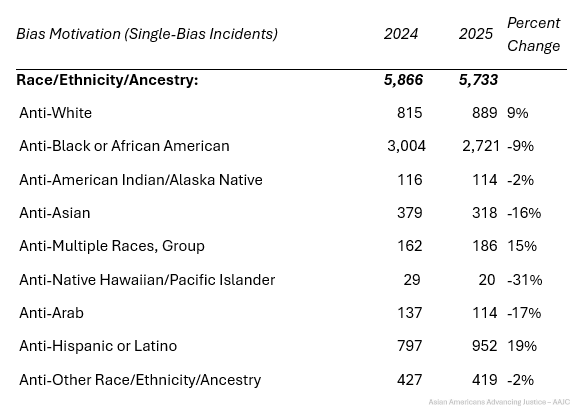
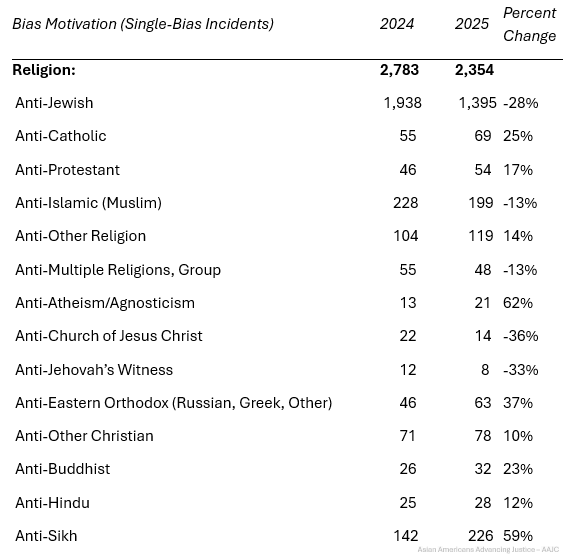
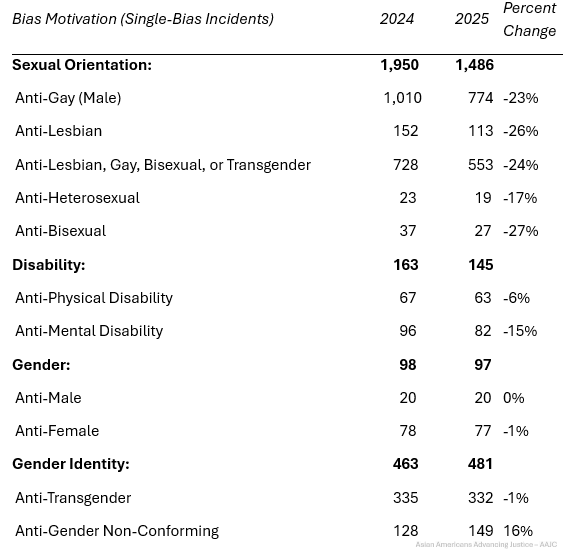
AAJC reiterates that the FBI’s data captures only a fraction of the harm experienced nationwide due to systemic under‑reporting and failures in law enforcement. The preliminary numbers are likely to change when the FBI publishes its official data tables later this year.
In response to this preliminary data, AAJC urges Congress to strengthen:
- Continued and increased funding for DOJ CRS and federal hate crime prevention grants to strengthen community‑based, non‑law‑enforcement strategies for addressing hate, including prevention, restorative responses, and trust‑building efforts in targeted communities.
- Passage of the Improving Reporting to Prevent Hate Act (IRPHA) to improve the accuracy, consistency, and completeness of law enforcement hate crime data collection.
- Increase resources for state‑run, non‑law‑enforcement hate crime reporting hotlines, as authorized under the COVID‑19 Hate Crimes Act and the Khalid Jabara Heather Heyer NO HATE Act, to ensure accessible, culturally competent reporting options outside of traditional policing systems.
- Robust civil rights enforcement to address discriminatory policing practices and related bad actors accountable for targeting communities on the basis of their identity.
Ideology, Policy, and the Normalization of Hate
We are deeply concerned that persistently elevated anti‑Asian hate and anti‑Latino incidents reflect the consequences of hate‑fueled ideology being advanced through political rhetoric and policy positions that embolden Americans to engage in violence, unlawful threats, intimidation, and other forms of bigotry against their neighbors.
This includes:
- Increased demonization of immigrants, fostering an environment where entire communities are treated as perpetually foreign and suspect based on race, religion, or national origin.
- The proliferation of the “great replacement theory”, a racist falsehood, has increasingly been applied by white supremacists against the South Asian community to inspire misinformation and discriminatory rhetoric and policies.
- Renewed scapegoating of China and Chinese communities, including attempts to revive discriminatory policies like the DOJ’s failed China Initiative, which the Department itself stated “can lead to a chilling atmosphere for scientists and scholars that damages the scientific enterprise in this country.”
“These dynamics reflect a profound abdication of responsibility by political leaders who have a constitutional duty to serve all Americans and to protect the nation from both domestic and foreign threats—including violent extremism against Asian and Latino communities,” said Sim J. Singh Attariwala.
Record ICE Impersonation and Community Terrorization
AAJC also highlights that 2025 saw a record number of Immigration and Customs Enforcement (ICE) impersonation incidents, with bad actors intentionally terrorizing communities perceived as ‘not American’ based on perceptions of race, ethnicity, nationality, religion, language, or immigration status
ICE impersonation, immigration‑based extortion, and vigilante enforcement efforts amplify fear well beyond any single incident, creating what advocates describe as “message‑based crimes” designed to intimidate entire communities. AAJC has identified policy solutions for state and local governments to curb this new type of threat.
While AAJC believes meaningful progress requires broader systemic change to prevent and address hate, the following policy solutions are offered as targeted interventions. We remind policymakers to continue to recognize the continuing challenges of over‑policing, limited access to restorative justice, and the fear and harm created by real or perceived alignment between law enforcement and ICE are all factors that deter impacted communities from reporting crimes and seeking protection.
AAJC calls on state and local law enforcement and prosecutors to:
- Investigate and proactively prevent ICE impersonation, immigration-based extortion, and false reporting schemes, recognizing that these tactics exploit fear fueled by immigration enforcement practices.
- Hold perpetrators accountable by charging qualifying conduct—such as ICE impersonation, immigration-based extortion, and false reporting—under applicable state and local hate crime statutes, to reflect the broader community-wide harm these acts inflict.
- Affirm clear institutional boundaries from ICE by publicly signaling that state and local authorities will not tolerate private individuals weaponizing immigration enforcement—or the fear of it—to intimidate, silence, or terrorize targeted communities.
- Reinforce community trust and safety by making clear that victims and witnesses can report crimes without fear of immigration consequences, and that public safety functions will not be used to advance federal immigration enforcement agendas.
Additional Resources
- StandAgainstHatred.org – A national initiative offering reporting options to confront hate and support affected communities.
- Asian Resource Hub – A centralized platform providing culturally specific resources, research, and support for Asian American communities facing hate and discrimination.
- RTB Bystander Intervention Trainings – Free interactive trainings that equip individuals with practical skills to safely intervene and respond to harassment and hate in real time.